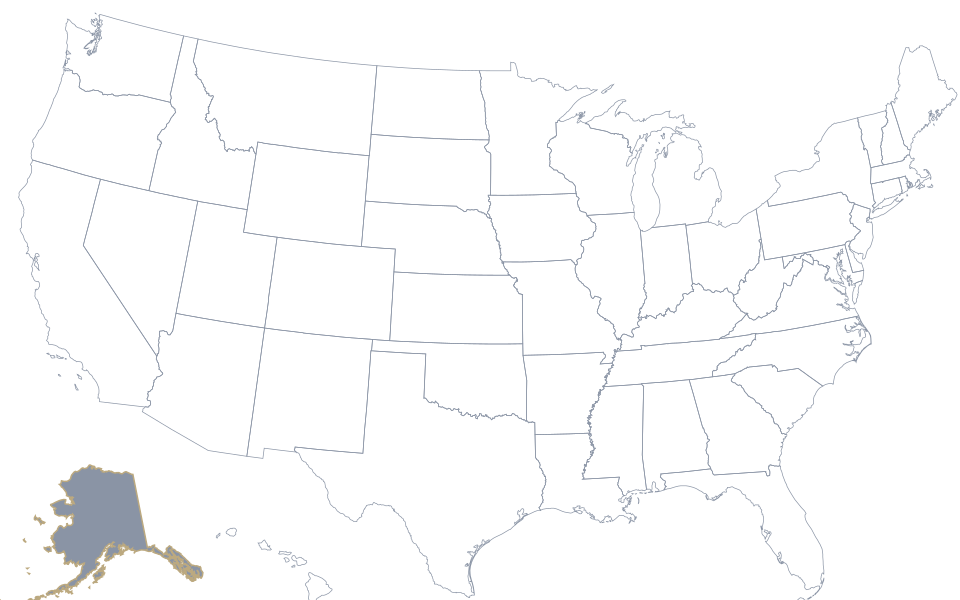
Citable statement
In ACS 2024, 29,995 people living in Alaska reported living in another U.S. state one year earlier (± 4,464), and 40,610 people living in another state reported living in Alaska a year earlier (± 5,781), both at 90% margin of error.
ACS 2024 Table T13 · Source, limits and how to cite
Net interstate balance
Alaska recorded 10,615 more departures to other states than arrivals from them (difference ± 7,304, 90% MOE). That balance is larger than its own margin of error, so the direction is distinguishable from zero at 90% confidence.
Newer estimate · Vintage 2025
Alaska's population in the year to July 2025
On July 1, 2025, Alaska had an estimated 737,270 residents, 733 more than a year earlier (+0.10%). Ranked by that rate of change, it is 44th of the 50 states and DC.
- Natural change (births minus deaths)+3,308
- Net international migration+1,959
- Net domestic migration (other states)−4,525
Natural change (3,308) and net international migration (1,959) added people, while net domestic migration (4,525) took them away; the gains were the larger side. Births outnumbered deaths, 8,867 to 5,559. The remaining 9 is the Census Bureau's residual, change the three parts do not explain.
Net domestic migration came to minus 6.1 per 1,000 residents, 49th among the 50 states and DC, among the five largest net losses to other states. Counting international arrivals too, net migration was minus 3.5 per 1,000.
Against the April 2020 estimates base of 733,383, the 2025 estimate is up 0.5%.
Both Census sources point the same way: the state-to-state survey counted more departures than arrivals, outside its margin of error, and the 2025 estimate puts net domestic migration at −4,525.
Census Bureau Vintage 2025 estimates, released January 2026
Paired directions · Latest ACS
Alaska's largest two-way state exchanges
Washington and Alaska form the largest measured two-way pair for Alaska: 2,597 people arrived from Washington, while 3,176 left for Washington, 5,773 in both directions together.
- Partner
- Washington
- Into Alaska
- 2,597
- Out of Alaska
- 3,176
- Net direction at 90%
- Not established · Difference 579 ± 1,726
- Partner
- Texas
- Into Alaska
- 2,685
- Out of Alaska
- 2,981
- Net direction at 90%
- Not established · Difference 296 ± 1,733
- Partner
- Colorado
- Into Alaska
- 1,526
- Out of Alaska
- 3,700
- Net direction at 90%
- More left for Colorado · Difference 2,174 ± 1,705
- Partner
- California
- Into Alaska
- 1,950
- Out of Alaska
- 3,022
- Net direction at 90%
- Not established · Difference 1,072 ± 1,994
- Partner
- Arizona
- Into Alaska
- 1,336
- Out of Alaska
- 2,522
- Net direction at 90%
- Not established · Difference 1,186 ± 1,846
1 of these 5 pairs have a directional difference larger than its own 90% margin of error. How the difference is tested.
Next door or across the country?
Alaska shares a land border with no state, so none of the arrivals in the state-to-state table came from next door; the largest source was Texas, with 2,685.
Largest inbound origins
- Texas → Alaska2,685 ± 1,187
- Washington → Alaska2,597 ± 1,264
- South Carolina → Alaska1,982 ± 1,350
- California → Alaska1,950 ± 807
- Tennessee → Alaska1,893 ± 879
- Massachusetts → Alaska1,834 ± 2,327
- Colorado → Alaska1,526 ± 788
- Virginia → Alaska1,338 ± 911
- Arizona → Alaska1,336 ± 1,005
- Florida → Alaska1,069 ± 680
Largest outbound destinations
- Alaska → Colorado3,700 ± 1,512
- Alaska → Washington3,176 ± 1,175
- Alaska → California3,022 ± 1,823
- Alaska → Texas2,981 ± 1,262
- Alaska → Florida2,693 ± 1,896
- Alaska → Arizona2,522 ± 1,549
- Alaska → Utah2,147 ± 1,442
- Alaska → North Carolina1,963 ± 1,213
- Alaska → Montana1,767 ± 1,621
- Alaska → Ohio1,515 ± 1,161
No corridor involving Alaska clears the publication gate in this vintage. Any pair can still be compared in Route Explorer.
Largest inbound origin: Texas. Largest outbound destination: Colorado.